Nobody thinks they will be the one to fall for a scam. Then a friend you trust shares a screenshot of a bank alert. A stranger on WhatsApp is kind and patient. A countdown clock is ticking. And you hear yourself say: "Let me just try with a small amount."
That is exactly how it works. Scammers do not look for foolish people. They look for people who want something good to be true: a way out of a hard month, a way to help family, a way to finally get ahead. Wanting a better life is not a weakness. It is just what they use against you.
This guide shows you how scams work, how to test any offer in minutes, and what to do if one gets you.
How most online money scams work
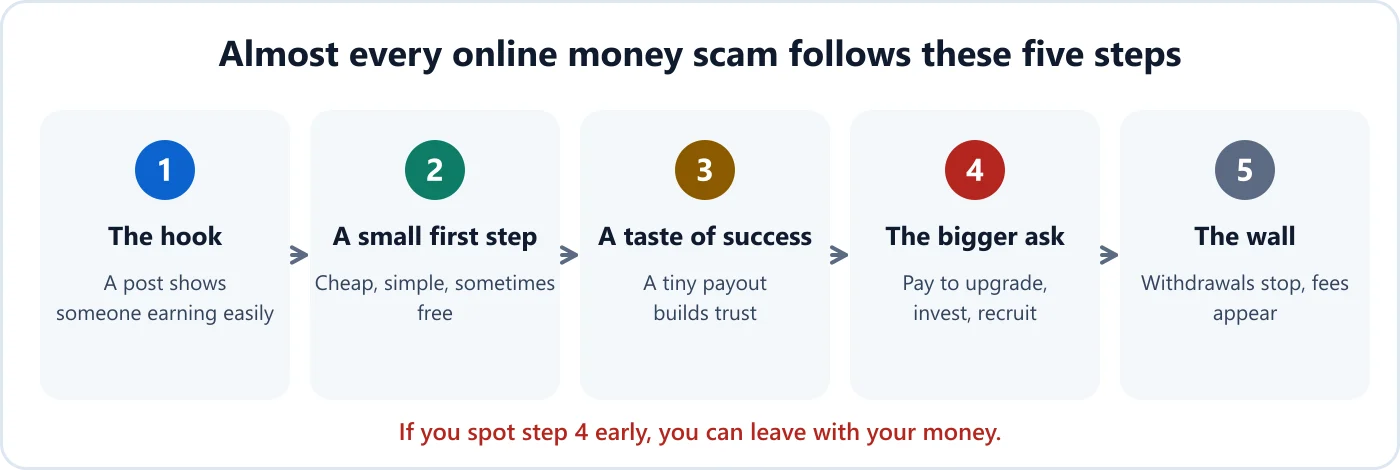
The five steps are: a hook (a post shows someone earning easily), a small first step (cheap, simple, sometimes free), a taste of success (a tiny payout that builds trust), a bigger ask (pay to upgrade, invest or recruit), and the wall (withdrawals stop and new fees appear). Once you see this pattern, you will notice it everywhere. The step to watch is the fourth one. Up to then, you may have lost nothing. After it, you lose a lot.
The 12 warning signs
1. You must pay before you can earn
This is the most reliable sign of a scam. A real employer or platform pays you. It does not charge you "registration", "activation", "verification" or "unlock" fees. If a business does charge for something, such as a paid course, it tells you plainly what you are paying for and does not tie it to your earnings.
2. It promises guaranteed or very high returns
"Double your money in 7 days." "Earn ₦20,000 daily." No honest business can guarantee that. The Securities and Exchange Commission has repeatedly warned Nigerians about Ponzi and unregistered investment schemes, including ones promoted on social media. A Ponzi scheme pays earlier members with money from newer members, and promises returns no real business could pay.
3. The returns come from new members
If you are paid mostly because other people join and pay, and not because of real work or a real product, it is a pyramid or Ponzi structure. It eventually collapses, and the people who joined last lose the most.
4. You are rushed
"Only 5 slots left." "This offer ends in one hour." Pressure is designed to stop you thinking, asking questions or checking. A real opportunity will still be there tomorrow.
5. You are told to keep it secret
"Do not tell your bank or your family why you are sending the money." Scammers isolate you because anyone you ask would warn you.
6. The company is vague
No clear name, no address, no terms of use, no way to reach a human, only a chat group and a link. Check how long the site has existed and what independent people say about it, beyond the testimonials on its own page.
7. The testimonials look too perfect
Screenshots of bank alerts, "proof of payment" photos and glowing messages are easy to fake. Real reviews come from people you can find outside the platform's own pages.
8. It asks for sensitive details
A bank or a regulated service may need your BVN. A task site or "investment" group has no reason to ask for your card PIN, your banking app password, your ATM details or the one-time code sent to your phone. Never share those with anyone.
9. Payments go to a personal account
If you are told to send money to a private person's account, or to a different account each time, treat it as a serious warning. Real businesses collect payments through clear, traceable channels.
10. The withdrawal process keeps changing
New fees appear, the minimum rises, or the site says your account is "frozen" until you pay "tax" or "insurance". These are not real fees. This is "the wall" in the five steps above: the point where the money stops coming back.
11. It borrows a famous name
Scammers copy logos of banks, government agencies and well-known companies. If a message says it is from a known institution, do not click its link. Go to the institution's official website or app yourself.
12. Something feels off
If you cannot explain in simple words how the money is made and who pays for it, you probably should not be in it. Trust that feeling and ask someone you trust.
"But it is registered": why registration is not enough
Many people check whether a company is registered, and that is a good step. For investments, the Securities and Exchange Commission has a way to check registration on its website. For businesses in general, the Corporate Affairs Commission has a public search.
But understand its limits. A registered name tells you a company exists. It does not tell you the company is honest. Some scam operations hide behind registered names. So treat registration as one useful check among several, never as proof on its own. Look at behaviour: what it asks you for, what it promises, and whether you can actually withdraw.
The scams Nigerians meet most
Learn the names, so you recognise them when they arrive.
- "Pay to unlock" task and job scams. You pay to start, then must pay again to withdraw.
- Ponzi and "investment" schemes. Fixed daily or weekly returns, paid from new members' money.
- Fake bank alerts. A customer sends a screenshot of a transfer that never happened. Always check your own account.
- "Wrong transfer" stories. Someone claims to have sent you money by mistake and asks you to send it back, while the first transfer was fake or reversed.
- Fake job offers. You are "selected" for a job and asked to pay for training, equipment or a background check.
- Fake giveaways. "Share this post and send your details to win." They collect your information, or ask for a fee to "release" the prize.
- Phishing. A text or call that looks like it is from your bank, asking for your PIN or the code that was just sent to you.
- Account takeovers. Someone you know seems to message you for money, because their account was taken.
- "Recovery agents". After you lose money, someone offers to get it back for a fee. It is usually the same people, coming back for a second round.
Five quick tests: can you spot the scam?
Test 1. A WhatsApp group admin posts: "Join our task group. Pay ₦3,000 for your starter pack and complete tasks to earn ₦15,000 a week." Scam. You are asked to pay before earning, and it promises a fixed weekly income.
Test 2. A platform shows what a task pays, asks you to follow a page and send a screenshot, and pays to your bank account once it is approved, with a minimum you can see. Possibly real, but verify. Do a few tasks, withdraw the minimum, and confirm the money arrives before you put in much time.
Test 3. A "forex trader" promises to turn your ₦50,000 into ₦200,000 in a month, and tells you not to mention it to your bank. Scam. Guaranteed returns plus secrecy.
Test 4. You get a text from an "official" bank number asking for the code that was just sent to you. Scam. No bank or service ever needs your one-time code.
Test 5. A job advert says you have been selected for a remote role and need to pay for a "background check" and a laptop. Scam. Real employers do not charge you to hire you.
How to check a platform in ten minutes
- Search the name with the words "scam" and "reviews". Look beyond the first result, and look for patterns.
- Look for terms of use, a privacy policy and support. A real company puts these where you can find them.
- Check how it behaves. Does it ask you to pay? Does it promise fixed income? Does it want your sensitive details?
- For investments, check registration on the Securities and Exchange Commission's website, remembering that registration alone is not proof of honesty.
- Test with the smallest possible step. For a task platform, earn the minimum and withdraw it before investing time. If it asks for money to let you withdraw, stop.
- Ask someone. A friend, an older relative or a bank customer service agent. Saying the offer out loud to another person is often enough to reveal what is wrong.
If you have already lost money
Do these things in order, and quickly.
- Stop sending money. No fee will "release" your funds.
- Call your bank straight away. Tell them what happened and give them the transfer details. Ask about their dispute process. Be aware that transfers you authorised yourself can be hard to reverse, which is why speed matters.
- Keep everything. Screenshots of the chat, the site, the account numbers and the receipts.
- Change your passwords. If you shared a password, a PIN or a code, change it immediately and turn on two-step verification.
- Report it. You can report online fraud through the official channels of the Nigeria Police Force's cybercrime unit and the Economic and Financial Crimes Commission. Investment schemes can also be reported to the Securities and Exchange Commission. Check each body's official website for current contact options.
- Warn others. Tell friends and family who might be targeted next.
How to help a friend who is being scammed
Do not shame them. They are probably already embarrassed. Ask questions instead: "How does the money get made?", "Can you withdraw?", "Who is behind it?" Help them test with a small withdrawal. Share this guide.
What a transparent platform looks like
Whatever you are testing, you should expect to see these things. This is how FiniTasks measures itself against them:
- You can see what a task pays before you start.
- It does not promise a fixed income, and says clearly that earnings are never guaranteed.
- The withdrawal minimum is stated: ₦1,000.00.
- Payouts go to a bank account in your own name, with a reference you can quote.
- Any fee on a withdrawal is small and shown before you confirm it.
- It never asks for your card PIN, bank password or one-time codes.
- If it has a referral programme, as FiniTasks does, that is a bonus. Your earnings should come from the work you do, not from recruiting people.
Check us the way you would check anyone: start small, and withdraw the minimum.
Do this today
- Think of any offer you are considering. Run it through the 12 signs.
- Send this guide to one person who is thinking of "trying something online".
- Turn on two-step verification for your WhatsApp and email.
Frequently asked questions
How can I know if a website is real or fake in Nigeria?
Check for clear terms and a privacy policy, a real way to contact the team, how long the site has existed and independent reviews. Search the name with the word "scam". Most importantly, check what it asks of you: a site that asks you to pay before you earn, or for your PIN or one-time codes, is not real.
What are the most common online scams in Nigeria?
Fake investment and Ponzi schemes, "pay to unlock" task and job scams, fake job offers that charge a fee, giveaway scams, fake bank alerts and phishing messages that ask for your one-time code.
Is this site legit?
Run it through the 12 signs and the ten minute check above. Look for independent reviews and test with the smallest possible withdrawal before you put in time or money. If anything on the list fits, walk away.
Can I get my money back after being scammed?
Sometimes, but not always. Reporting to your bank immediately gives the best chance. Keep your evidence and report to the relevant authorities. Be careful of anyone who offers to recover your money for a fee.
How do I report an online scam in Nigeria?
Tell your bank first. Then use the official reporting channels of the Nigeria Police Force's cybercrime unit and the Economic and Financial Crimes Commission. Investment-related schemes can also be reported to the Securities and Exchange Commission.
Are all task and survey sites scams?
No. Many are real and pay small amounts for real work. The difference is how they behave: real ones show you the pay up front, do not ask you to pay to start, and pay to your bank account. Always test with a small withdrawal first.
Can a scam site look professional?
Yes. A good-looking website proves nothing. Judge a platform by how it behaves: what it asks you for, what it promises, and whether you can actually withdraw.