The question sounds simple: which websites pay Nigerians? But there are two very different versions of it.
One is the question of a person who has spent months clicking, installing and "completing offers" for sites that never paid. They are tired, and a little embarrassed, and they want a straight answer.
The other is the question of a person who has not been burned yet, and is about to be.
This guide is for both. It does not give you a list of sites to trust, because lists age badly and anyone can be added to one for a fee. It gives you something better: the five families of sites that genuinely pay Nigerians, how their payouts work, where the fees hide, and a ten minute test you can run on any site yourself.
The five families of sites that pay Nigerians
1. Micro-task platforms
You do small jobs such as following a page, leaving a comment, subscribing to a channel, joining a group or installing an app, and you are paid for each approved job. The pay per task is shown before you start, and the work needs no special skill. FiniTasks is one of these.
What to expect: the pay is shown on each task before you start, and there is a minimum balance before you can withdraw.
2. Freelance marketplaces
Clients post jobs, and you apply: writing, design, editing, translation, assistant work and more. Large international marketplaces such as Upwork and Fiverr are open to freelancers in Nigeria, and there are local and regional ones too. The platform takes a share of what you earn.
What to expect: higher pay, real competition, and usually payment in dollars that you then withdraw to a Nigerian bank. Your first job is the hardest to win.
3. Survey and feedback sites
Companies pay for your opinions or for feedback on a product. Some are genuine market research firms.
What to expect: low pay, work that comes and goes, and a lot of sites that exist to collect your data. Never pay to join, and never share your card details.
4. Selling platforms
You sell goods or services and customers pay you, whether through your own social media pages, a marketplace or a shop. There is no "site" that pays you, because your customers do.
What to expect: your income depends on your product, your price and how well you serve people. Our guide on promoting a business on social media covers finding customers.
5. Creator programmes
YouTube, Meta and other platforms share advertising money with creators who meet their rules. Eligibility depends on your country and your numbers, and it changes, so read each platform's own pages.
What to expect: the slowest and the least certain, but it can grow into something real for those who stay consistent.
What "pays in naira" really means
This is where many Nigerians get surprised, so read it twice.
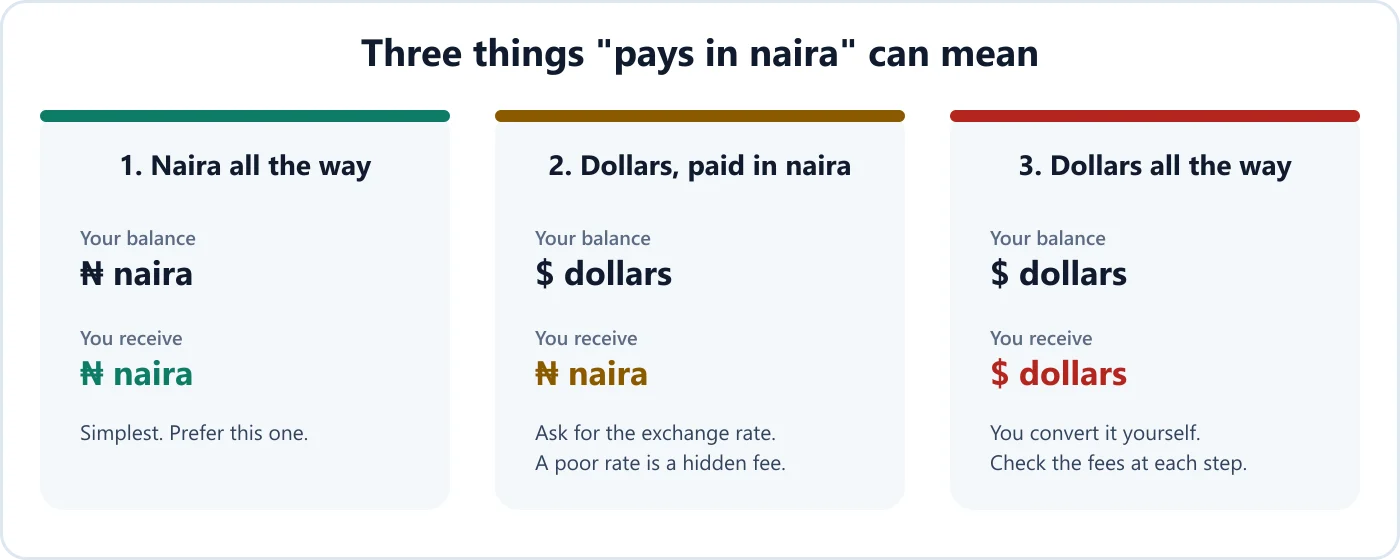
- Naira all the way. Your balance is in naira, and naira lands in your Nigerian bank account. This is the simplest. You know what you earned and you know what you will receive.
- Dollars in, naira out. Your balance is in dollars, and the platform pays you out in naira at its own exchange rate. The danger is the rate. A poor rate is a fee that never shows up on a fee list. Ask what rate is used, and compare it with a recent rate from a source you trust.
- Dollars all the way. You receive dollars into a payment service or a domiciliary account (a bank account that holds foreign currency), and convert them yourself. This is common with international freelance sites. It works well, but check the fees at every step: the platform's withdrawal fee, the payment service's fee and the exchange rate you get.
None of these is automatically bad. The trouble comes when you do the work first and discover which one you are in afterwards.
Where the fees hide
Fees are rarely printed in large letters. Look in three places.
The rate. If a platform converts dollars to naira, the gap between its rate and the real market rate is its fee.
The withdrawal step. Some platforms charge a flat fee or a percentage each time you withdraw. Ask what it is, and whether it is deducted from your balance or charged on top.
The minimum. If you must reach a high minimum before you can withdraw, small earners can wait a very long time. A low and clearly stated minimum is a good sign. On FiniTasks, the minimum is ₦1,000.00, it is shown on the site, and a small bank transfer fee is taken from each withdrawal and shown before you confirm.
How a real payout works
Understanding the steps takes the fear out of the process.
- You do the work, and the platform records it.
- The work is checked and approved, or rejected with a reason.
- Approved earnings move into your available balance.
- When your balance reaches the minimum, you request a withdrawal.
- The platform checks that the account name matches your name on the platform.
- The transfer is sent to your bank, with a reference you can quote.
- The money appears in your account. If it is late, you take the reference to your bank.
If a site cannot tell you how any of these steps work, ask why not.
The ten minute test
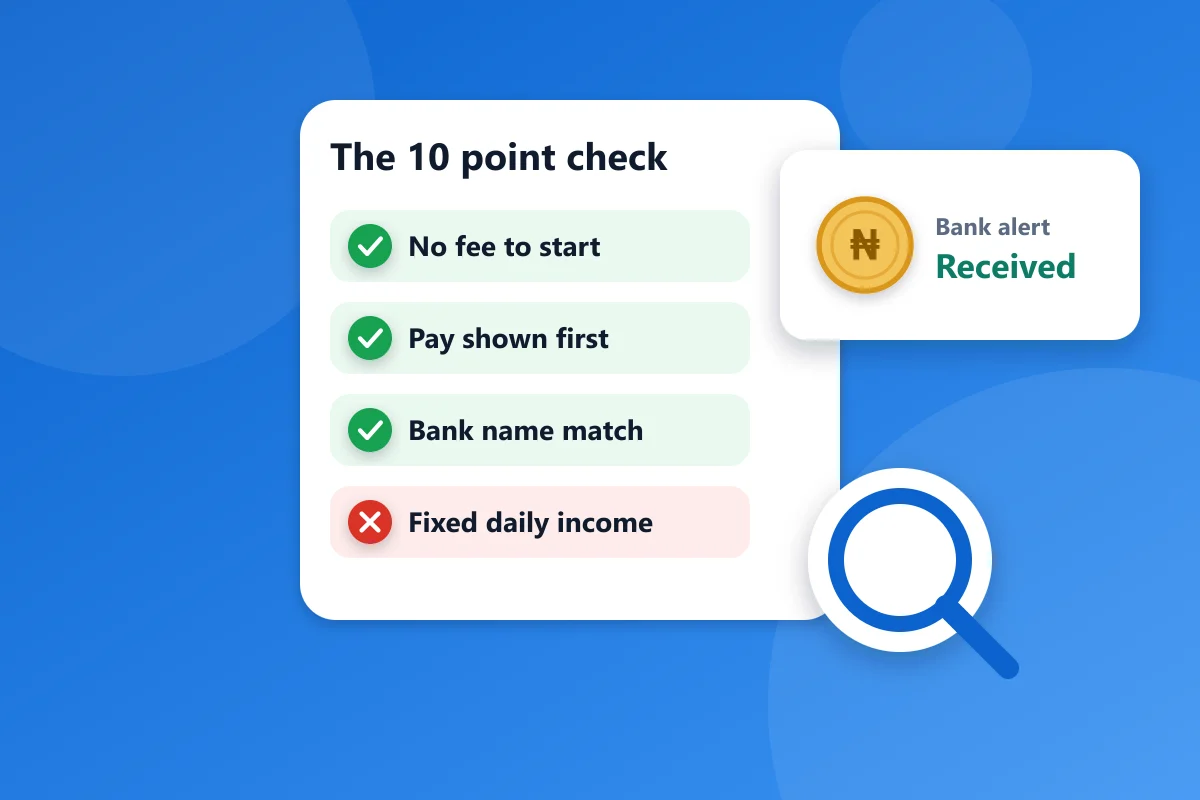
Before you give a site your time, put it through five quick questions. These are the ones that separate real payers from the rest. For the full list of warning signs, read how to know if an online money site is a scam.
- Does it ask for money before you can earn? If yes, stop.
- Can you see exactly what each job pays before you start? If no, be careful.
- Is the minimum withdrawal clear? If it is hidden or keeps changing, walk away.
- Does it pay to a bank account in your own name? If it wants a card number, your PIN or a one-time code, it is not a payer. It is a thief.
- Can you earn the minimum and withdraw it? This is the real test.
How FiniTasks answers these questions
We would rather you check than trust, so here is what we can say, in the same order.
- Money before you earn: Joining is free. Be wary of anyone using our name who asks you for money to "unlock" tasks.
- Pay shown first: every task shows what it pays, in naira, before you start.
- Minimum: ₦1,000.00, shown on the site.
- Bank account: the name on your FiniTasks account must match your bank account name, and transfers carry a reference you can quote to your bank.
- Sensitive details: we never ask for your card PIN, bank password or one-time codes.
- Nothing taken out: the amount you withdraw is the amount that leaves.
129,000+ tasks have been approved on FiniTasks, and 6,100+ people have had work approved. Earnings are never guaranteed. Start small, and test us the same way you would test anyone else.
Mistakes people make when chasing paying sites
- Joining five at once. Pick one, and learn how it works before adding another.
- Believing screenshots. Bank alerts and "proof of payment" can be faked. Test with your own small withdrawal instead.
- Ignoring the rate. A site that pays "instantly" at a bad rate is not paying instantly. It is paying you less.
- Doing hours of work before a first withdrawal. Test early.
- Sharing a card number to "verify" an account. Never.
Do this today
Pick one site you were thinking of trying. Run it through the five questions above, and write the answers down. If it passes, do enough work to reach its minimum, withdraw it, and watch your bank account. That one small test is worth more than any list of "top paying sites".
Frequently asked questions
Which website pays the most in naira in Nigeria?
There is no single answer, and be careful of sites that claim to be "the highest paying". Pay depends on the kind of work. Micro-tasks pay per job, and the pay is shown before you start. Freelance work pays more but needs a skill and a portfolio. Selling and creator programmes can pay the most but take the longest.
Are apps that pay you to install other apps real?
Some are legitimate marketing programmes, but the pay is usually very small, and many are built to collect your data or send you to sites that ask for money. Apply the five questions, and never share card details or one-time codes.
Can I get paid daily?
Some platforms let you withdraw as soon as you reach their minimum, which could be daily if you earn enough. Do not trust any site that promises daily income. Look instead at how withdrawals work and how long they take once you request one.
What is the difference between a real task site and a scam?
A real one shows you the pay before you start, never asks you to pay to earn, and pays to a bank account in your own name. A scam talks about money first, promises fixed income and asks for your sensitive details. Our guide on spotting a scam shows the signs in detail.
Do I need a domiciliary account to get paid in dollars?
Not always, but it is worth asking your bank about. Some freelancers receive dollars through a payment service and withdraw to a naira account, and others use a domiciliary account. Compare the fees and exchange rates before you choose.
Do I pay tax on money I earn from these sites?
Money you earn can be taxable depending on how much you earn and your circumstances. If your online income grows beyond small amounts, keep records and check the current rules with a qualified adviser.