You open Instagram, and there is the advert again. "1,000 followers for the price of a plate of rice. Delivered in minutes." You are a small business owner with 87 followers and a product you are proud of. You are tempted.
That is a normal reaction. A bigger number looks like trust, and trust is what small businesses need. But there is a gap between what the advert says and what you actually receive, and many Nigerian business owners fall into it.
A note on honesty before we begin. FiniTasks is a platform where businesses pay real people to complete small tasks on social media, so we have a stake in this topic. We will tell you where our model fits and where it does not, and we would rather you make a good decision than a quick sale.
What "growth services" actually are
When someone sells you followers, likes, views or comments, they are usually reselling from one of a few sources.
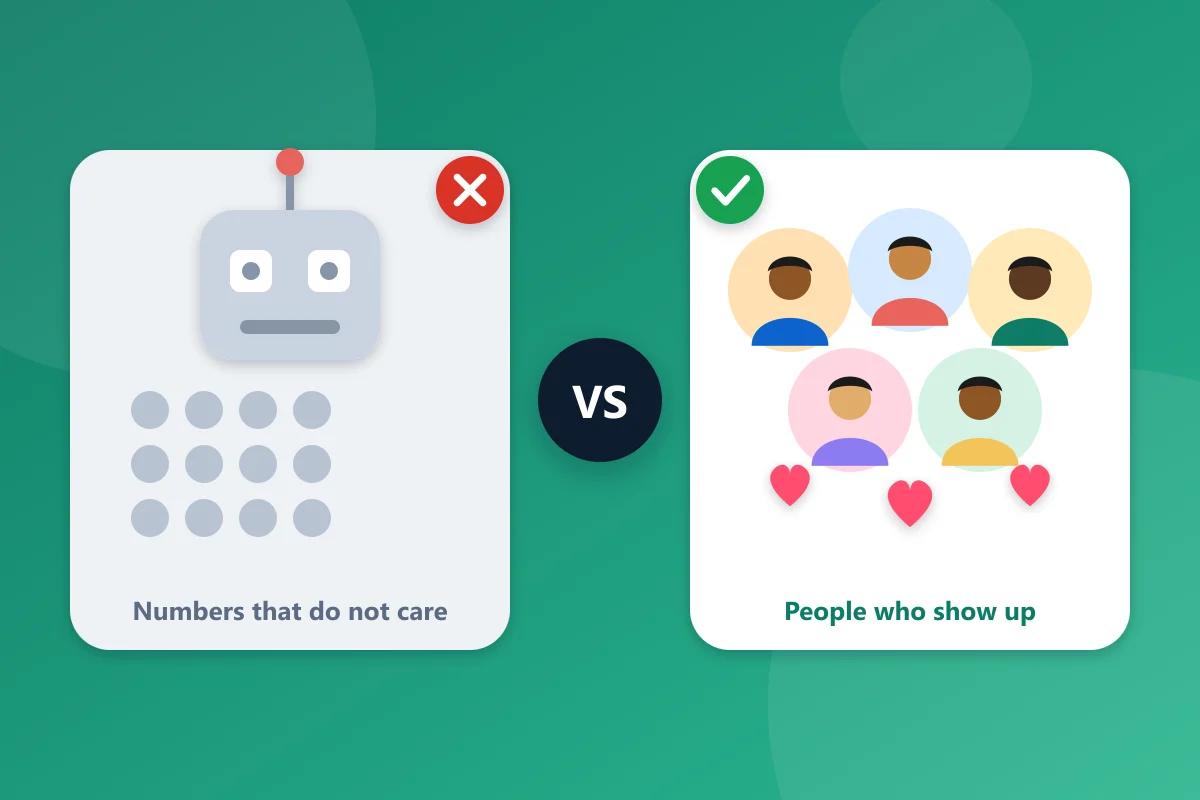
1. Bots. Software controls hundreds or thousands of fake accounts. They follow your page and do nothing else. They are cheap, fast and worthless.
2. Fake or farmed accounts. Real-looking accounts created in bulk and run by operators. They can look slightly more real than bots, but they are still not people who care about your business.
3. Real people doing paid tasks. Genuine users, with their own accounts, are paid a small amount to follow, like, comment or subscribe. The engagement is real activity from real accounts, but the people were paid, not persuaded.
4. Organic growth. People find you, like what you do, and follow because they want to. It is slower, and it is the only source that produces loyal customers.
An "SMM panel" (social media marketing panel) is a website that resells these services. Many are resellers: they do not own any accounts. They pass your order to a supplier, who passes it to another supplier. You rarely know which of these four you are buying.
The kinds compared
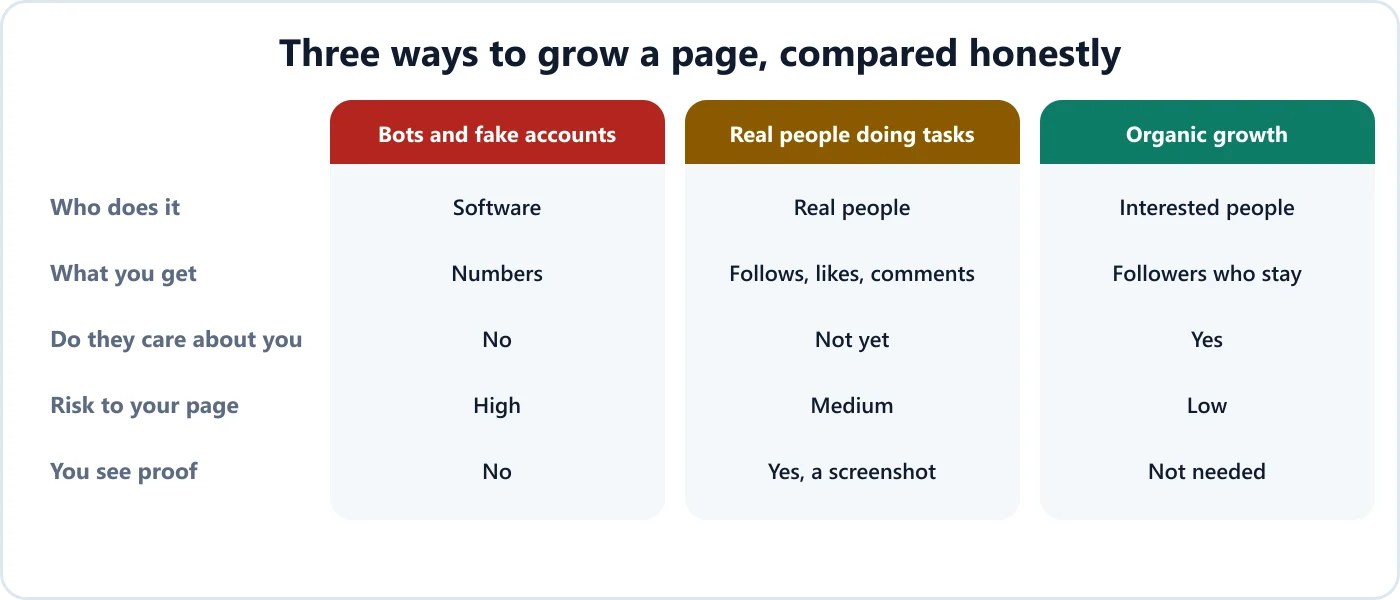
The picture merges the first two sources (bots and fake accounts) into one column. Read across the rows: who does it, what you get, whether they care about you, the risk to your page and whether you see proof. The thing you most want, someone who cares about your business, is exactly what only organic growth gives. Paid growth can make a page look active. It cannot make people care.
What can go wrong with paid growth
The numbers drop. Fake accounts get removed by the platform over time. You pay for 1,000 followers and you wake up one day with 400. Sellers who advertise "non-drop" followers, meaning followers who will supposedly never disappear, are making a promise that depends on what the platform does next, and you cannot enforce it.
Your reach suffers. Platforms measure how many of your followers react to your posts. If thousands of followers never engage, your posts can look unpopular and get shown to fewer people.
You break the platform's rules. Major platforms prohibit artificially inflating followers and engagement. How strictly they act varies, but the risk is real, and it falls on your account, not on the seller.
You hand over your password. Some sellers ask for your login "to deliver faster". Never share it. It is the commonest way accounts get stolen.
You pay and nothing arrives. Some "panels" are just scams that take money and disappear. Anyone can set up a website.
Customers can tell. A page with 20,000 followers and four likes on every post looks strange, and strangers notice.
The cost per follower is the wrong number
Business owners often compare prices by cost per follower: "₦X for 1,000". That number tells you almost nothing. What you care about is:
- How many enquiries did this bring?
- How many customers?
- What did each customer cost me?
A bot follower that costs almost nothing and brings zero customers has an infinite cost per customer. A smaller number of interested people who buy has a low one. Always compare in customers.
Seven questions to ask before you pay anyone
Use these on any seller, including us.
- Where do the accounts come from? If they cannot say, or just say "real", ask for more detail. Bots and fake accounts are the usual answer behind a vague reply.
- Will you ask for my password? If yes, walk away. No honest seller needs it.
- Can I see proof of each action? A platform that shows you what was done and lets you approve or reject it is behaving differently from one that sends you a number at the end.
- What happens if the numbers drop? Ask for the refill or refund terms in writing, and be realistic about whether they can be enforced.
- How fast will it arrive? A thousand followers in an hour looks like exactly what it is. Gradual delivery looks more natural, though it does not make the accounts real.
- What do the platform's rules say? Read the current rules for the platform you are using, and decide whether you accept the risk.
- What is the smallest test I can do? Never put your whole budget into your first order. Try a very small one and look at who actually arrives.
Where real people doing tasks fit
Because this is our field, here is a clear description of what it is and is not.
On FiniTasks, workers link and verify their own social media accounts, and a business posts a task, such as following a page, liking a post or leaving a comment. The business chooses how many people it wants, and each worker sends a screenshot as proof. You see the proof for each task and approve or reject it.
What it is good for:
- Giving a new page its first signs of life, so that real visitors are not put off by an empty page.
- Adding some activity around a launch, such as a new product or an event.
- Getting proof you can check for every action you pay for.
What it is not:
- It is not the same as organic growth. The people were paid, so they are not yet your customers.
- It does not remove platform-rule risk. Paid engagement is paid engagement, even when real people do it.
- It does not guarantee results. A task is a task done by a real person. What happens next depends on your page.
If you use it, use it lightly, and keep most of your effort on the thing that actually makes people buy: your content, your replies and your service.
What organic growth really takes
Organic growth is not free. It costs time and consistency, and it pays off in people who stay.
- A profile that makes sense in seconds. Our guide on getting your first 1,000 Instagram followers shows how.
- Content that is useful. Posts people save and share.
- Conversation. Replying to every comment and message, and speaking to your customers where they are.
- Proof. Reviews, photos and results, collected and shown.
- Referrals. Asking happy customers to bring a friend.
Our guide on promoting a business on social media with little money puts these into a 30 day plan.
Which should you choose? Three small stories
These are examples to think with, not real customers.
A baker with a new Instagram page. She has good photos and no followers. Organic growth is her main path: content, replies, and reviews from her first customers. If she wants to try a small push so the page does not look empty, she might use a modest task campaign alongside this, and watch whether visitors become orders.
A musician releasing a track. The risk is that fake numbers undermine the real fans. Organic first. Anything paid should be tiny and tested.
A new online store with a product launch next week. A small, careful push before launch to avoid an empty page can make sense, but the real work is the launch content and customer service.
The pattern is the same: the more your business depends on trust, the more organic growth matters.
A simple rule of thumb
Put most of your time and money into things that make people want to follow you, and treat anything paid as a small seasoning, not the meal. Measure customers, not numbers. If a method stops bringing customers, stop paying for it.
Your first three moves
- Write down what you are really trying to achieve: sales, bookings or enquiries. Not "more followers".
- Look at your last ten posts. Which got saves, comments or messages? That is your proof of what works.
- If you are tempted by a paid service, ask the seven questions above, and start with the smallest possible test.
Frequently asked questions
What is an SMM panel?
An SMM panel is a website that resells social media services such as followers, likes, views and comments. Many are resellers of other resellers. The quality ranges from bots to, sometimes, real accounts, and it is rarely clear which you are buying.
Is buying followers illegal in Nigeria?
As far as we know, buying followers is not a crime in itself, but check the current rules, and it goes against the rules of the major platforms. The main risk is to your account and your reputation.
What does "non-drop" mean?
It means the seller claims the followers will not disappear. In practice, it is a promise about what the platform will or will not remove, which the seller cannot control. Treat it as marketing, not a guarantee.
Do bought followers help sales?
Bot followers do not buy. A real person who was paid to follow is also not yet a customer. Only content, trust and service turn followers into sales.
Can real people following my page hurt my account?
Platforms have rules about paid engagement, and we cannot promise how any platform will treat a particular account. Read the rules, keep it small, and never let it replace real content.
How do I grow my page without paying?
Make a clear profile, post useful content, reply to everyone, collect and share reviews, and ask customers for referrals. It takes time, but it produces followers who care.