You have uploaded eight videos. You have 14 subscribers, and nine of them are your cousins. Every morning you open the app, hoping for a number to have moved.
If that is you, here is some comfort and some honesty. Comfort: almost every successful channel began exactly here, with nobody watching. Honesty: waiting will not fix it. What fixes it is understanding why people click, why they stay, and why they subscribe, and improving each step one at a time.
This guide walks through all three, with examples that fit Nigerian viewers and Nigerian data costs.
How a stranger becomes a subscriber
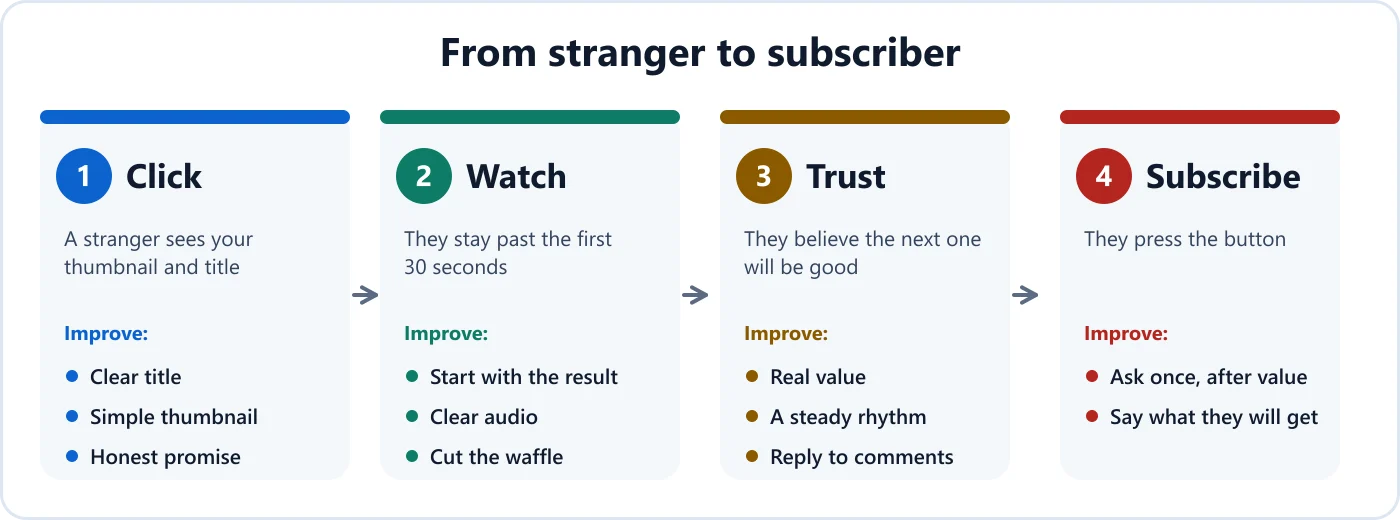
Every video is a small funnel. Many people see your thumbnail and title. Some click. Some of those stay. A few of those subscribe. If you want more subscribers, you improve the narrowest part of that funnel, one step at a time.
Step 1: choose a niche and make a promise
A niche is the one subject your channel is about. A channel that posts random videos gives a stranger no reason to subscribe. A channel that promises something specific does.
Complete this sentence: "I help [who] to [do or learn what] by [how]."
For example: "I help Nigerian students learn Excel in 10 minutes a day by showing real exam questions." Or: "I help busy workers cook healthy lunches for under ₦2,000."
That sentence is your channel promise. It decides your topics, your titles and your banner. You can change it later, but pick one for the first 20 videos.
Good niches fit things you can explain, show or enjoy for a long time: school and exam help, cooking, phone and tech tips, small business advice, beauty and hair, fitness at home, music and instruments, comedy and skits, farming, language lessons, repairs.
Step 2: set up your channel so it explains itself
When someone clicks your name, your channel page has a few seconds to answer: "Is this for me, and will it be good?"
- Channel name. Clear and easy to spell, ideally hinting at your topic.
- Profile picture. A clear face or logo.
- Banner. One line that states your promise.
- Description. What you make, who it is for, how often you post, and how to contact you.
- A channel trailer or pinned video that shows your best work to new visitors.
- Links. Your WhatsApp, Instagram or business page.
Step 3: win the click with titles and thumbnails
You can make the best video in the world, and nobody will see it if the thumbnail and title do not make them curious. This is the step where most beginner channels are stuck.
Titles
- Say what the viewer gets. "How to Make Jollof Rice Without Burning It" beats "Cooking Video 5".
- Be specific. Numbers and results help: "5 Excel Formulas Every Student Needs".
- Use words people really search. Think about what a Nigerian would type: "how to save data on Android", "how to start a POS business", "JAMB reading timetable".
- Be honest. A title that promises something the video does not deliver gets clicks once, then loses trust.
Thumbnails
- One clear idea, big and simple. Most people see it small on a phone.
- A face showing a clear emotion often works, and so does a striking before and after.
- Large, readable text with only a few words.
- Strong contrast, so it stands out in a crowded feed.
- Do not copy others. Make yours recognisable as yours.
A quick test: shrink the thumbnail to the size of a postage stamp. If you cannot tell what it is about, redo it.
Step 4: win the stay in the first 30 seconds
People decide very quickly whether to stay. In Nigeria, many also worry about data, so a video that wastes time loses viewers fast.
- Start with the result or the problem. "By the end of this video, you will be able to..." Do not begin with a long introduction.
- Say less, show more. Cut pauses, repeats and waffle.
- Keep the audio clear. Poor sound loses viewers faster than poor video. Record in a quiet room, close to the phone's microphone, and away from fans and generators if you can.
- Light your face. Sit facing a window.
- Plan for your connection. If uploading on a weak connection is a problem, upload at night when the network is lighter, or on Wi-Fi, and keep your videos at a size you can afford to upload.
- Give viewers reasons to keep watching. Tease what is coming: "In a minute I will show you the mistake almost everyone makes."
- Match the video to the title. If you promised something, deliver it early.
Step 5: Shorts or long videos?
Short vertical videos can be a good way to be discovered, because they reach viewers who are not searching for you yet. Longer videos are where you build trust and where deeper viewing happens.
For a beginner, a sensible mix is to make short videos that tease or summarise your topic, and longer videos that go deeper. Use Shorts to introduce people to you, and long videos to keep them.
Step 6: help people find you through search
YouTube is also a search engine, and a lot of its viewers are looking for answers.
- Put your main phrase in the title and early in the description.
- Write a useful description with a short summary, and links to related videos.
- Add chapters with timestamps for longer videos, so viewers can jump to what they need.
- Study what your viewers search. Type your topic into the search bar and note the suggestions, because those are real searches.
- Answer questions people actually ask. Comments are a gold mine of video ideas.
Step 7: ask for the subscribe the right way
People subscribe when they believe the next video will be good. So the best time to ask is right after you have delivered something valuable.
- Ask once, clearly, and tell them what they will get: "If you want a new Excel tip every Tuesday, subscribe."
- Do not ask in the first ten seconds, before you have earned it.
- Reply to comments. Subscribers come from feeling noticed.
Step 8: take your channel to where Nigerians already are
You do not have to wait for the algorithm.
- Share each new video on your WhatsApp status and in relevant groups, but give people a reason: a tip, not just a link.
- Post a short clip on Instagram, Facebook or TikTok with a pointer to the full video.
- Collaborate with other small creators in your niche. A guest appearance or a shout-out brings you an audience that is already interested.
- Answer questions elsewhere, such as in comments and groups, and mention your video when it genuinely helps.
- Ask your first real viewers what they liked, and make more of it.
A word on monetisation
Many beginners ask when YouTube will start paying them. The honest answer is that it depends on your country and the current rules.
At the time of writing, YouTube's main programme for earning from advertising typically needs a channel to reach about 1,000 subscribers plus either 4,000 public watch hours or a very large number of Shorts views, and a lower, earlier tier with some features exists in some places. The rules change, and the details differ, so check YouTube's own pages for the current requirements and for how payments reach Nigeria. You will also need to set up payment details and verify your identity and address through the process YouTube gives you.
Two practical points. First, many creators earn from sponsors, from selling their own products or services, or from referring viewers to a business long before advertising pays much. Second, do not build your whole plan on one platform's payment rules. Build an audience that trusts you, and the earning options will follow.
Do not buy subscribers
It is tempting, but it works against you.
- They do not watch. Subscribers who never open your videos tell YouTube that people do not want what you make, which can reduce how often your videos are shown.
- They break the rules. YouTube's policies prohibit artificially increasing views, subscribers and other metrics.
- They can disappear. Fake accounts are removed over time, and your count drops.
- They may not impress sponsors. Many sponsors care more about how many people actually watch than about the subscriber count.
If you are curious about the difference between bots, paid real-person activity and organic growth, read social media growth services versus organic growth. YouTube's policies prohibit paying for subscribers or views, including from real people, and doing so can put your channel and any future monetisation at risk. We would not recommend it.
A 90 day plan
| Days | Focus |
|---|---|
| 1 to 14 | Choose your channel promise. Set up the channel. Make your first 3 videos with strong titles and thumbnails. |
| 15 to 45 | Post on a rhythm you can keep, such as one video a week. Improve your first 30 seconds. Reply to every comment. |
| 46 to 75 | Look at your best video and make more like it. Add Shorts that point to your long videos. Collaborate with one other creator. |
| 76 to 90 | Review what worked. Cut what did not. Set your next 90 day goal. |
What to measure
Do not obsess over the subscriber count. Look at:
- Click-through rate: how many people who saw your thumbnail clicked. If it is low, improve titles and thumbnails.
- Average view duration: how long people stay. If it is low, improve your opening and pacing.
- Returning viewers: whether people come back.
- Which videos bring new subscribers: make more like them.
Your first three moves
- Write your channel promise: "I help [who] to [what] by [how]."
- Pick your best existing video, and redo its thumbnail and title.
- Plan your next three video titles, using words people really search.
Frequently asked questions
How can a beginner get more YouTube subscribers in Nigeria?
Choose a specific niche, make videos with clear titles and thumbnails, give viewers value in the first 30 seconds, use words people search, promote your videos where Nigerians already are, and be consistent. Subscribers come when people trust that your next video will be good.
How many subscribers do I need to make money on YouTube?
It depends on the programme and the current rules, which differ by country and change over time. Check YouTube's own pages for the latest. Many creators earn from sponsors and their own products before ads pay much.
Is it safe to buy YouTube subscribers?
No. Bought subscribers do not watch your videos, which can hurt how your channel is shown, and it breaks YouTube's policies. Real viewers are worth far more.
Do I need an expensive camera to start?
No. A phone with good light, a quiet room and clear audio is enough. Titles, thumbnails and the first 30 seconds matter more than the camera.
How often should I post?
Choose a rhythm you can keep for months. For many beginners, one good video a week is better than several rushed ones. Consistency matters more than volume.
Why are my videos not getting views?
The usual reasons are weak titles and thumbnails, a slow start, unclear audio, or a topic nobody is searching for. Check which of those fits, fix one thing at a time, and see what changes.